A Conversation with Adri Ramos, LCSW
You Can Handle More Than You Think
Meet Adri - Part 1
Your path to therapy is unlike most, you started as an abortion doula, sex educator, prenatal and postpartum doula, and domestic violence advocate. How do those experiences live in your clinical work today?
Some context: As a young person I had a lot of beliefs about mental health issues and mental health treatment, and healthcare in general. Accessing that kind of care, let alone providing that care felt like it required highly special circumstances. Medication and therapy were for when things were REALLY bad with your mental health; when you couldn’t possibly cope on your own. To me, therapists and doctors were especially bright and effective people who were in perfect health who knew and experienced how to be well in their own lives (lol).
During college I started to fumble my way through figuring out how to care for myself. I didn’t have health insurance for a while during those days, I worked at bars and restaurants, and I had to access sliding fee scale healthcare. One of the places where I ended up seeking care really helped destigmatize so many of the health issues I was experiencing.The care I received was straightforward, kind, and just… helpful! I ended up working at that place after I graduated from college! It felt very relevant to my life at that point. I got to work as a helper, not an expert with all the answers, but with some concrete and relatively simple training and tools to guide people through their own challenging health experiences.
As a domestic violence advocate and birth doula I worked with predominantly women, who I often saw myself in. It was kind of like… “we are not so different, and I have struggled and received help from others and so I’m here because I want to help this time! And I have some special tools for this now.”
So, fifteen years later, I feel similarly about my role as a mental health therapist. Yes, I do have specific skills and training, and some solid years of experience treating mental health issues, at this point. Also, as I like to joke to my clients sometimes, I ain’t special! In fact, I too have struggled with mental health issues–it turns out a lot of people do. As a therapist, it feels so important for me to not be on a pedestal, because if I am then I cannot meet people where they are right now. A big part of my work is recognizing how I can relate to the person across from me in a way that is helpful to them, and de-emphasizing any possible power imbalance.
You studied at the University of Washington, doing work in gender and racial equity alongside your doula and advocacy work. How does that lens, thinking about systems, identity, and power, show up when you’re working one-on-one with an individual client?
There is this old saying, “the personal is political,” and in social work school I remember a professor joking, “the personal is professional.” The idea here is that our personal experiences are informed and shaped by larger systems of power. Us social workers often choose helping work informed by the way systems have impacted us. For me, my experiences with accessing and working in reproductive health care and being a Latinx woman, for example, felt essential to understanding how I wanted to show up as a clinical social worker providing health care to people in need.
Mental health issues like PTSD or anxiety or depression, do not happen in a vacuum. It’s helpful to be able to put people into broader contexts of family, community, and culture. These systems inform peoples’ values, resources, and strengths, which all help me to identify paths forward. For therapy clients, it is especially useful in developing treatment plans that feel tailored to an individual.
You’ve been practicing in Missoula for over a decade. What keeps you here? What does this community offer, or need, that keeps you engaged?
My people keep me here! And the proximity to mountains and water. I have people who I love and who love me that support me when things are challenging, and that I can play and celebrate with when things are good. Being able to be active outside and close to loved ones are essential to my wellbeing. Missoula offers community, and it is far from perfect, but it feels good to participate and do my small part here.
EMDR has a reputation for being mysterious, or even a little strange, to people who’ve never heard of it. How do you explain it to a new client who is curious but has no idea what it is?
Simply put, EMDR is a type of exposure therapy where we work with facing the trigger (a memory or a strong emotional or psychological experience), increasing our tolerance for it for short bursts of time, and then reprocessing the trigger with the goal of adapting how we respond to challenging memories or other internal experiences.
What drew you to EMDR specifically? Was there a moment, a training, a client outcome, something you witnessed that convinced you this was something worth learning deeply?
I trained in EMDR when I was working at a community health clinic where I was seeing a lot of complex trauma amongst my clients. The main tools I offered at that point were based in mindfulness and CBT (which are great, and still part of my practice), but I also felt like I wanted to offer a trauma specific treatment to better serve what I was seeing in the population I was working with.
What does an EMDR session actually feel like from the inside? What is the client doing, what are you doing, and what tends to happen in the room?
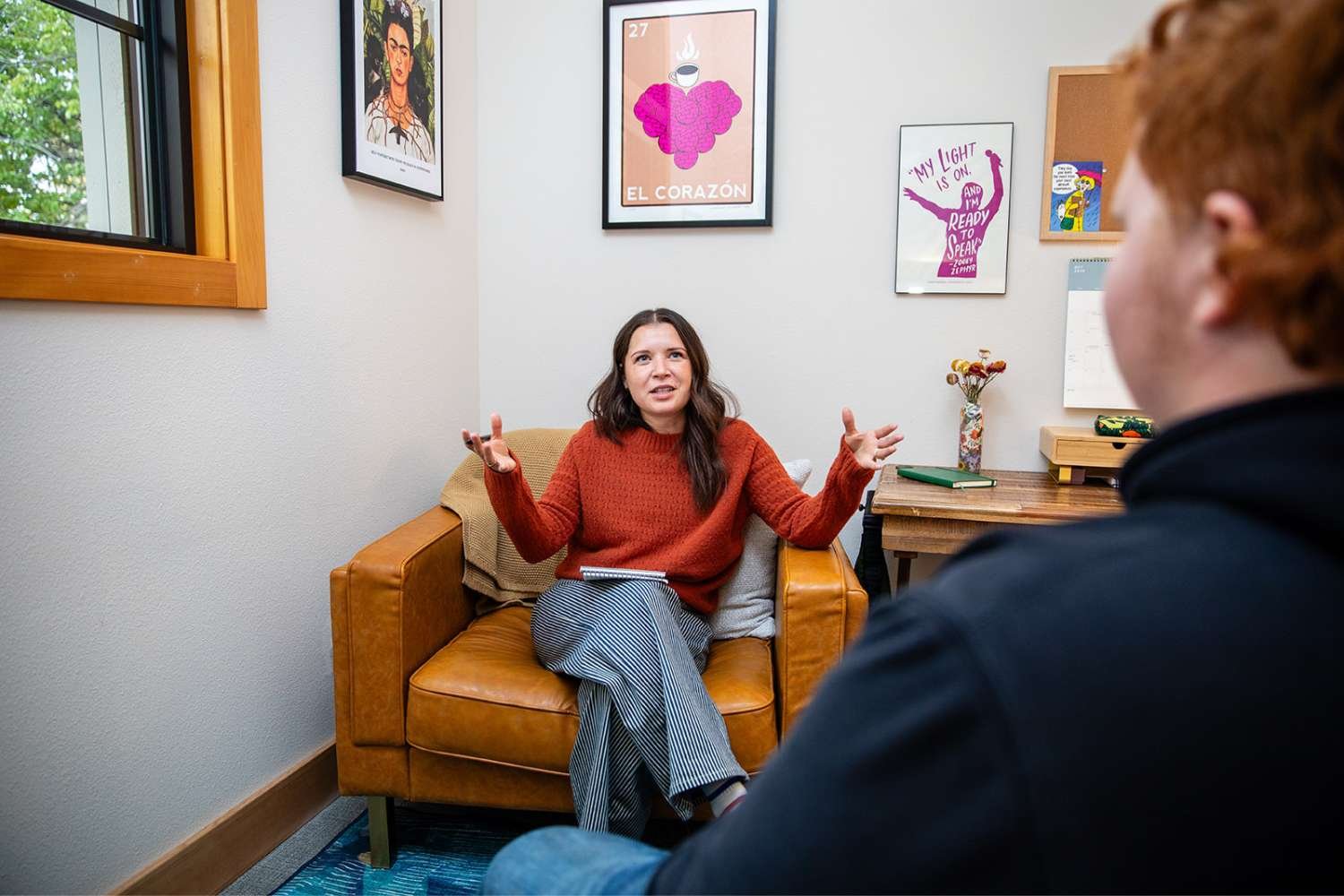
It can feel weird, especially when we start initial processing. An EMDR session can happen in a regular 55 minute therapy session. When I introduce EMDR to clients we do a fair amount of set up which includes several sessions to develop what we call “resources” in EMDR. These are mindfulness, visualization or somatic tools to help clients practice emotional regulation in between sessions. From there we work together to identify a “target” to process. This is typically a strong memory or experience associated with dysregulation for the client. In sessions when we are processing the client is focusing their awareness on the memory and I facilitate bilateral stimulation (BLS), which in my office is typically tapping on knees but can also look like passing a ball back and forth, or me passing my hand back and forth in range of client’s gaze. We do this in short intervals, helping the client sit with whatever comes up emotionally and mentally from focusing on the target, and as session goes on, helping client to digest how the target impacts them.
Are there situations where you’d choose a different approach over EMDR? How do you decide which tool fits which person and which moment?
Yes! EMDR is not for everyone. A lot of us like and prefer good old fashioned talk therapy! When people come to me I can–and do– have lots of ideas of what might be helpful, so I provide psychoeducation around what I do, and then I collaborate with clients to see what they want and what feels workable and accessible for them.
You describe yourself as believing that ‘people are innately resilient and adaptive.’ What does holding that belief actually change about how you work? What would you do differently if you didn’t hold it?
Remembering we all have innate resilience and can adapt, helps me to remain hopeful, and also keeps me grounded in this idea that I am not some special expert. I have skills, experience, and space to accompany my clients in their healing, but they are the ones who change their lives.
Honestly, I have had moments where I lose sight of this and I might think “this is what you should do” or “if it were me,” and those moments are my cue to remember I am not the boss! I am a steward.
Learn more about Adri with Part 2!